What are the 4 Types of Data in Data Science?
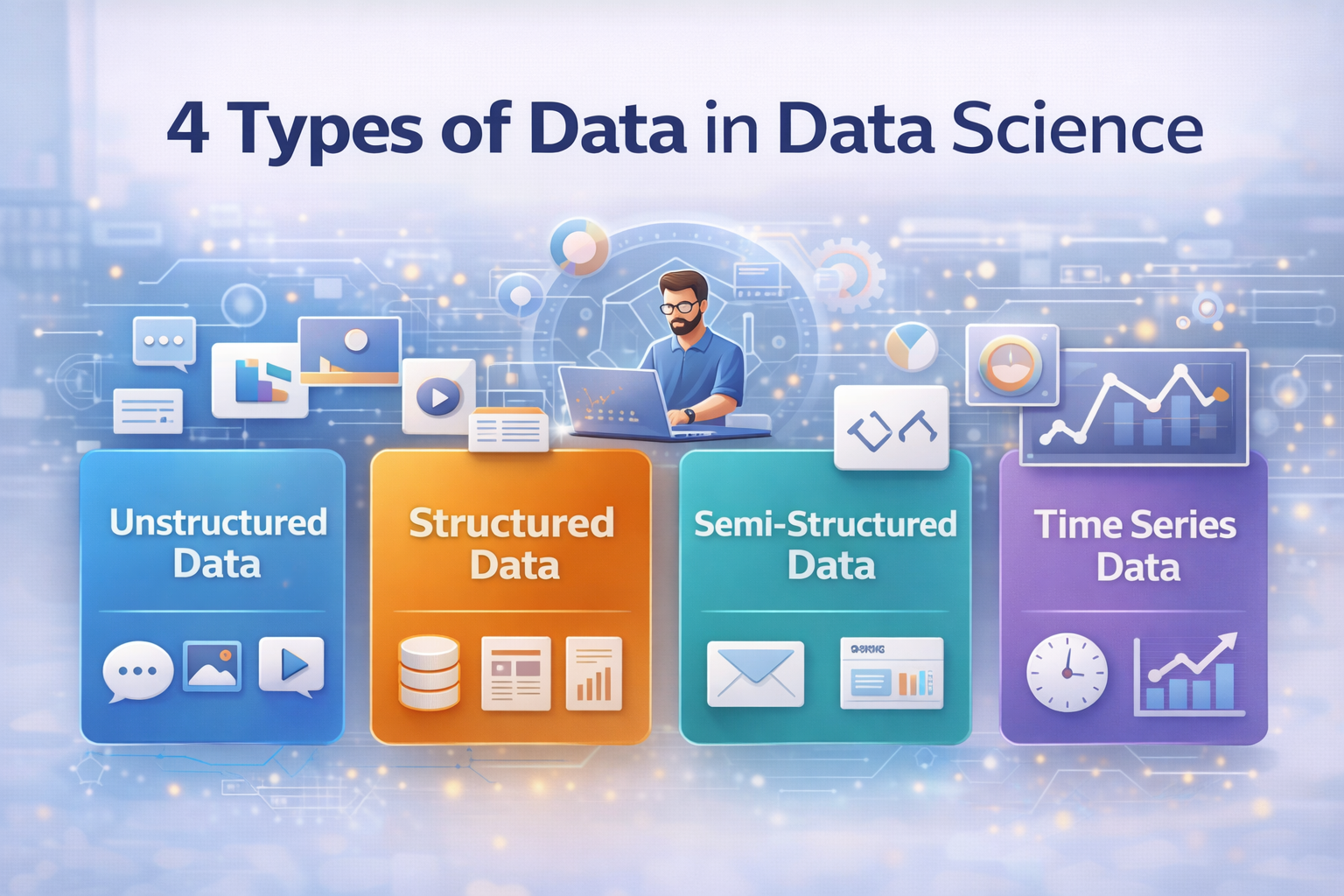
In Data Science, data is commonly grouped into four broad types based on how it is organized and used. Understanding these types helps data scientists choose the right tools, storage methods, and analytical techniques.
1) Structured Data
Structured data is highly organized and fits neatly into rows and columns, making it easy to store in relational databases and analyze using SQL. Each field has a defined data type, such as numbers, dates, or text. Examples include customer records, transaction logs, sales reports, and inventory tables. Because of its fixed schema, structured data is the easiest to query, visualize, and model, and it forms the backbone of traditional business intelligence systems.
2) Semi-Structured Data
Semi-structured data does not follow a rigid table format but still contains tags or markers that provide structure. This makes it more flexible than structured data while still being machine-readable. Common examples include JSON, XML, HTML files, email headers, and NoSQL database records. Semi-structured data is widely used in web applications and APIs, and it requires specialized parsing and processing techniques before analysis.
3) Unstructured Data
Unstructured data has no predefined format or organization, making it the most complex type to analyze. It includes text documents, social media posts, images, audio recordings, videos, and PDFs. This type of data accounts for the majority of data generated today. Data scientists rely on techniques such as natural language processing (NLP), computer vision, and deep learning to extract meaningful insights from unstructured data.
4) Metadata
Metadata is “data about data.” It provides contextual information such as when data was created, its source, format, size, and ownership. Examples include file creation dates, database schema descriptions, and image resolution details. While often overlooked, metadata is crucial for data governance, quality control, discovery, and efficient data management.
Together, these four data types form the foundation of
modern data science, enabling organizations to extract value from diverse and
complex data sources.
STLabs India
Leading IT training institute providing industry-ready courses with 100% placement assistance.